
Welcome back to weekend coffee chats, the Business Breakdown series. Where we discuss different industries, businesses, and what we can learn from them.
We’ve been discussing recently F1 and what lessons can be learned from it. If you haven’t read part#1 check it it out here.
We’ve already discussed the main characters of F1 or the people in the spotlight, so this week let’s look behind the curtain, let us turn the camera on the crew and the people behind the scenes that have an impact, the team. (I’m including the car as part of the team)
I think one of the interesting aspects of F1 is how big the teams are. It is common to have multiple people behind a an athlete, a sports team, or a brand. Yet the numbers seen in F1 are quite high that it’s very interesting. “You’ll find that every Formula 1 team has about 300 to 970 employees consisting of constructors, strategists, engineers, drivers, and mechanics considered to be industry leaders in their respective fields.” – Ref#1
What’s interesting is that the performance of each and every one of these members affects the end goal of the entire team which is winning races and/or earning points. In businesses usually you have each team working on a separate milestone to reach the end result, or in some cases a few teams work in parallel, but to have majority of teams working in parallel to reach the goal is quite uncommon and interesting. (in the industry I work in at least)
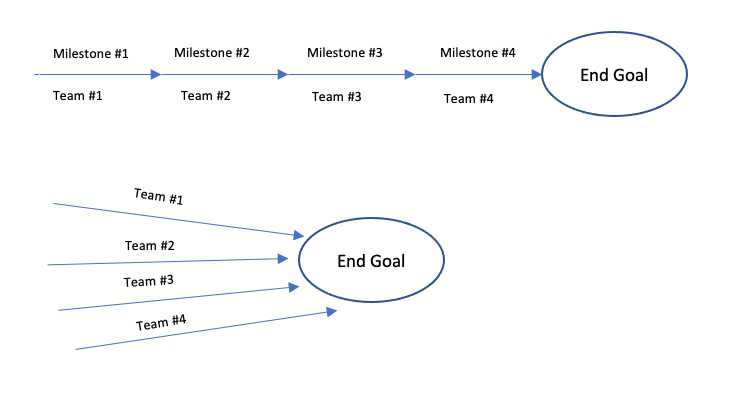
Take for example a race weekend where the pit crew (the team responsible to change the tyres during the races) has a delay for some reason, end result of the race gets affected. Or if the engineering team wasn’t able to finalize some changes to the car in time before the next race, penalties for the whole team and end result of the race gets affected. It’s so dynamic that it’s quite clear that for the driver to win, the whole team needs to be strong and performing exceptionally. It rarely happens that a driver wins without a strong team behind them. Therefore a strong team is not optional but a necessary part of the process.
Now I’d love to find out more details about how these teams are managed and trained to excellence, yet finding this information publicly is as challenging as one would imagine, probably due to competitiveness and trade secrets I’d assume. (Let me know in the comments if there’s articles or books that you’re aware of that I could look into)
What I could piece together though is the below points, which got me first thinking that those are valuable lessons most industries can take and learn from. Yet upon re-thinking it hit me that these are the founding blocks of good management and efficiently running a business. So where did things go wrong that one industry applies this to a T while others throw it out the window ? No clue, but it could probably be traced to having the right people and experts advising them that to achieve great results these blocks are a non-negotiable vs. what others see as a nice-to-have.
- right people in the right place – industry leaders in their fields
- strong and clear Leadership – especially in team principles
- Focus on data
- Focus on driver’s input
- constant communication – on race weekends they have multiple meetings before and after the races
- constant learnings and advancements between races and seasons to keep up with their industry and competitors
I mean it looks simpler than a chocolate cake reciepe, however the impact of doing the above consistently and patiently race after race and year after year, shows a huge difference between the competing teams. It does beg the question that the solution could be simple and straightforward yet the commetment and patience is what’s hard.
I think this served as a reminder that theory works in practice if applied, constant feedback sought, and adjustments and improvements constantly made. Since I’m an employee myself I won’t be suggesting the sugar coated “drive change” solution, as I’m aware of the challenges we all face in our workplaces. It is true that we can drive change yet such a magnitude of change needs alignment from top management rather than our simple suggestions. What we can do probably is start having these discussions, focusing on what areas have been missed for so long that can be applied and rally for change among other team members, managers, and directors. Of course it’s worth mentioning that these could also be a sign of a good company to join or one to leave (in case majority of the points are absent or are being dropped)
One of the above points that really got me thinking is the focus on the driver’s input. A lot of times feedback from people in the field or closest to the end consumer or company goal gets overthrown by data. Not to say the data isn’t important, as it is, however it could be misleading without some qualitative input and insights – Ref#3. So it’s such a breath of fresh air to see the driver’s input being taken into consideration and adjustments are made based on it, not despite it.
Such a phenomenal example and the referenced research has provided me with evidence based argument to bring to future discussions. I think this topic is very important for business, as the higher up the management the more their work is focused on communication and goals achievement and the less they’re in tune with what the end consumer is searching for. (Unless you work for Amazon, as these guys seem to know what we want before we even want it, spooky, but more on that in a separate post)
The other side:
Of course it’s important to note that we’re placing the spotlight on the advantages to learn from them, yet it’s not a perfect sport and there are disadvantages that need to be worked on and improved. Starting with the huge budgets that these teams use which causes them to constantly seek new investments (some even allegedly shift the politics of the teams). It’s a disadvantage as one could argue these funds are better placed to solve other issues the world is facing like global warming and poverty. Yet one could also argue if humans are prevented from forms of entertainment that cost money to produce, then that’s preventing them from the joys of life and being humane in an attempt to robotize them. Others also point out that capping investments per year should help reduce this issue but big strides are still needed. (Which is something FIA already started doing this year -Ref#4). So many valid arguments and the debates continue, fueling a valuable discussion.
Another is how dangerous this sport is, drivers put their lives on risk every time they race even for practice races. Even though the industry had made strides in terms of higher safety standards, unfortunate deaths still occurred in the past couple of years. – Ref#2
Everything in life comes with risks that’s a given, however how high is that risk vs how needed is that activity is a trade-off that’s always considered and reconsidered.
We’ll however stop here and leave this for next week’s post, in additioan to finally getting to discuss the co-stars of the sport, (and maybe even future solo star? who knows?) the cars.
Let me know in the comments if there’s a topic you’d like to see in the F1 posts or the other posts.
Till next time 🙂 !
Disclaimer: None of this information is to be used as advice, it’s just for entertainment purposes. Additionally all information used is publicly available.
References:
Ref#1: https://www.planetf1.com/news/a-closer-look-at-the-cost-of-running-an-f1-team/#:~:text=The
Ref#2: https://www.gq.com/story/f1-crash-jules-bianchi-racecar-driver
Ref#3: https://www.nngroup.com/articles/risks-of-quantitative-studies/
Ref#4: https://www.formula1.com/en/latest/article.the-2021-f1-cost-cap-explained-what-has-changed-and-why.5O1Te8udKLmkUl4PyVZtUJ.html
 Weekend Coffee Chats
One thought on “Lessons from F1 for Business Professionals Part#2”